
Mathematical Olympiads are prestigious competitions fostering problem-solving skills, and readily available PDF resources, containing challenges like the sought-after “1000 Mathematical Olympiad Problems”,
are invaluable preparation tools for aspiring mathematicians globally.
What are Mathematical Olympiads?
Mathematical Olympiads are challenging, globally recognized competitions designed to identify and nurture exceptional mathematical talent in students. These aren’t simply tests of rote memorization; they demand creative problem-solving, logical reasoning, and a deep understanding of mathematical principles. They range in difficulty, from school-level contests to the prestigious International Mathematical Olympiad (IMO).
The core of Olympiad preparation often revolves around tackling a vast number of problems. This is where resources like collections of “1000 Mathematical Olympiad Problems” in PDF format become incredibly useful. These compilations provide extensive practice, exposing students to diverse problem types and strengthening their analytical abilities. Participating in these Olympiads isn’t just about winning; it’s about the intellectual journey and the skills developed along the way, preparing students for future STEM endeavors.
The Value of Solving Olympiad Problems
Engaging with Olympiad problems, particularly those found in extensive PDF collections like a compilation of “1000 Mathematical Olympiad Problems”, offers benefits far beyond simply preparing for competitions. These problems cultivate critical thinking, enhance problem-deconstructing skills, and foster a deeper appreciation for the elegance of mathematics.
The process of struggling with – and ultimately solving – challenging problems builds resilience and a growth mindset. Working through a large problem set allows students to identify their weaknesses and focus their study efforts effectively. Furthermore, exposure to diverse problem types, as offered by such comprehensive PDF resources, broadens mathematical understanding and prepares students for advanced studies in STEM fields. It’s about learning how to think, not just what to think, a skill valuable in all aspects of life.
Why Use PDF Problem Sets?
PDF problem sets, especially those containing a vast number of problems like a “1000 Mathematical Olympiad Problems” collection, offer unparalleled convenience and accessibility for aspiring mathletes. They eliminate the need for constant internet access, allowing for focused study anytime, anywhere. This format is ideal for printing and working through problems offline, fostering a distraction-free learning environment.
Furthermore, PDFs are easily searchable, enabling students to quickly locate problems based on topic or difficulty. They often include solutions, allowing for self-assessment and independent learning. The portability of PDFs means students can carry a substantial library of challenging problems on a single device. Utilizing these resources efficiently streamlines preparation and maximizes study time, proving invaluable for success in Mathematical Olympiads.

Popular Mathematical Olympiads & Their Difficulty Levels
Olympiads like the IMO and SOF IMO present varying challenges; mastering a large problem set, such as “1000 Mathematical Olympiad Problems”, is crucial for success.
International Mathematical Olympiad (IMO)
The International Mathematical Olympiad (IMO) stands as the most prestigious worldwide secondary school mathematics competition, renowned for its exceptionally challenging problems. Preparation demands rigorous training and exposure to a vast range of problem types. Consequently, resources compiling extensive problem sets, like collections containing “1000 Mathematical Olympiad Problems” in PDF format, become incredibly valuable assets for aspiring contestants.
Success at the IMO isn’t merely about memorizing formulas; it requires deep conceptual understanding, creative problem-solving abilities, and a knack for elegant proofs. Working through a substantial number of problems, as offered in these comprehensive PDFs, helps students develop these skills. These resources often categorize problems by topic – algebra, geometry, number theory, and combinatorics – allowing focused practice. Furthermore, analyzing solutions and understanding different approaches is paramount. A dedicated study plan incorporating such PDFs is often a cornerstone of IMO preparation, building both confidence and mathematical maturity;
SOF International Mathematics Olympiad (IMO) ⎯ Details & Syllabus
The SOF International Mathematics Olympiad (IMO), geared towards students in grades 1-12, assesses mathematical aptitude and logical reasoning. While less demanding than the international IMO, effective preparation still requires dedicated practice. Utilizing resources like collections of “1000 Mathematical Olympiad Problems” available in PDF format can significantly enhance a student’s performance. The syllabus covers a broad spectrum of mathematical concepts, progressively increasing in complexity with each grade level.
These PDF problem sets provide ample opportunity to familiarize oneself with the types of questions asked and hone problem-solving techniques. Consistent practice with these materials, alongside understanding the core syllabus topics, is crucial. Students benefit from working through varied problems, analyzing solutions, and identifying areas needing improvement. Access to a comprehensive PDF resource streamlines preparation, offering a structured approach to mastering the mathematical skills tested in the SOF IMO.
Other Notable Olympiads (e.g., AMC, AIME)
Beyond the SOF IMO and IMO, several other mathematical competitions offer valuable experience and challenge students of varying skill levels. The American Mathematics Competitions (AMC), including the AMC 8, AMC 10, and AMC 12, serve as stepping stones for many aspiring Olympians. Further advancement often leads to the American Invitational Mathematics Examination (AIME). Preparing for these exams benefits greatly from utilizing extensive problem sets, such as those found in “1000 Mathematical Olympiad Problems” PDF collections.
These PDF resources provide a diverse range of problems, mirroring the difficulty and scope encountered in these competitions; Consistent practice with these materials builds crucial problem-solving skills and familiarity with common contest techniques. Students can leverage these PDFs to identify their strengths and weaknesses, tailoring their study plans accordingly. Mastering the concepts within these problem sets is a strong foundation for success in any mathematical olympiad.
Finding “1000 Mathematical Olympiad Problems PDF” Resources
Locating a comprehensive “1000 Mathematical Olympiad Problems PDF” requires careful searching, prioritizing legitimate sources to ensure quality content and avoid potential risks.
Legitimate Sources for PDF Downloads
Finding reliable sources for a “1000 Mathematical Olympiad Problems PDF” collection demands discernment. Several platforms offer curated problem sets, often requiring registration or purchase. Art of Problem Solving (AoPS) is a highly respected resource, providing extensive materials, including challenging problems and comprehensive solutions, though a direct “1000 problems” PDF might not be available as a single download.
University websites, particularly those with strong mathematics departments, sometimes host past Olympiad exams or practice problems in PDF format. Checking the websites of organizations running specific Olympiads, like the International Mathematical Olympiad (IMO), can also yield valuable resources. Educational publishers specializing in mathematics competition preparation frequently offer downloadable PDF samples or complete problem books for purchase. Be cautious of free downloads from unknown sources, as these may contain errors, incomplete solutions, or even malicious software. Always prioritize reputable providers to ensure the quality and integrity of the materials.
Identifying Reliable Websites & Authors
When searching for a “1000 Mathematical Olympiad Problems PDF”, verifying the source’s credibility is crucial. Look for websites with a clear reputation within the mathematics community. Authors affiliated with universities, renowned mathematics educators, or established competition training centers are generally trustworthy. Check for author biographies and qualifications to assess their expertise.
Reliable websites typically feature transparent contact information, a privacy policy, and secure payment gateways if purchases are involved. Scrutinize user reviews and forum discussions to gauge the experiences of others. Websites hosting content from well-known mathematical organizations, like the IMO or national mathematics Olympiad programs, are usually safe bets. Be wary of sites with excessive advertisements, grammatical errors, or a lack of clear attribution for the problems presented. Prioritize sources that emphasize problem-solving techniques and detailed solutions alongside the problems themselves.
Avoiding Copyright Infringement & Scam Sites

Downloading a “1000 Mathematical Olympiad Problems PDF” requires caution regarding copyright. Many problem sets are protected intellectual property; unauthorized distribution is illegal. Opt for legally obtained resources – official publications, licensed materials, or websites with explicit permission to share the content; Avoid sites offering free downloads of copyrighted material, as these contribute to intellectual property theft.
Beware of scam websites disguised as legitimate providers. These sites may request personal information, credit card details, or install malware. Look for secure connections (HTTPS) and verify the website’s domain name. If a deal seems too good to be true, it likely is. Prioritize established platforms and reputable publishers. Always use updated antivirus software and exercise caution when clicking on links or downloading files from unfamiliar sources. Supporting legitimate creators ensures continued access to quality mathematical resources.
Types of Problems Found in Olympiad PDFs
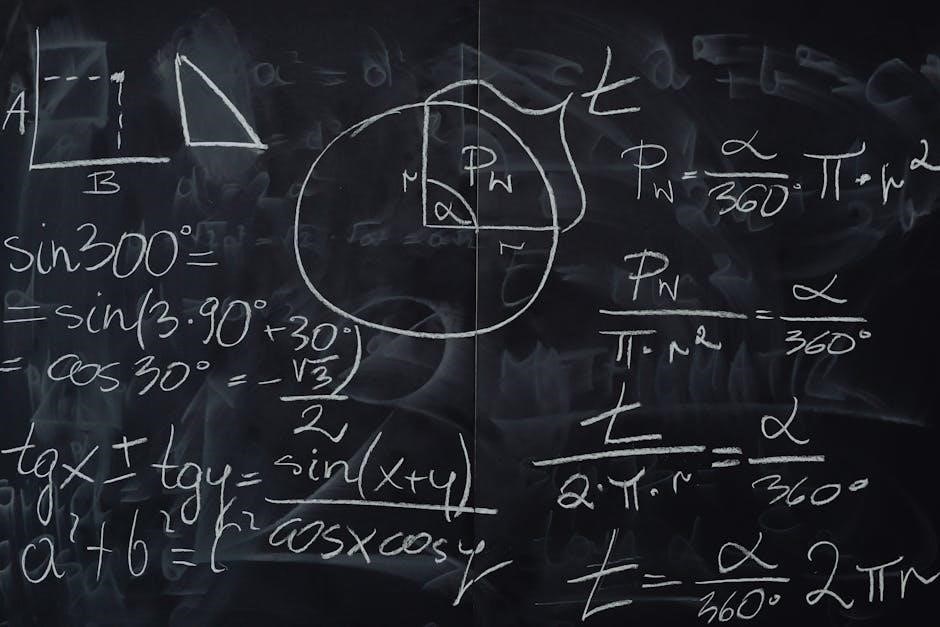
“1000 Mathematical Olympiad Problems PDF” collections typically encompass diverse areas: algebra, challenging geometry, intricate number theory, and ingenious combinatorics, demanding strong analytical skills.
Algebra Problems
Within the vast landscape of a “1000 Mathematical Olympiad Problems PDF” compilation, algebra consistently forms a substantial and crucial component. These aren’t your standard textbook equations; Olympiad-level algebra delves into polynomial factorization, functional equations, inequalities, and systems of equations with a sophisticated twist. Expect problems requiring clever manipulation, insightful substitutions, and a deep understanding of algebraic identities.
Many problems demand a creative approach, moving beyond rote memorization of formulas. You’ll encounter challenges involving Diophantine equations – finding integer solutions – and problems that cleverly disguise algebraic relationships within seemingly complex scenarios. The difficulty escalates rapidly, often requiring a blend of algebraic skill and logical reasoning. Mastering these concepts is vital, as algebraic techniques frequently underpin solutions in other areas like geometry and number theory. A strong foundation in algebra is, therefore, paramount for success in mathematical olympiads.
Geometry Problems
A comprehensive “1000 Mathematical Olympiad Problems PDF” will invariably dedicate a significant portion to geometry, often representing a considerable challenge for many students. These problems transcend typical high school geometry, demanding a mastery of Euclidean geometry, trigonometry, and analytical geometry. Expect to encounter problems involving triangles, circles, quadrilaterals, and more complex shapes, requiring clever constructions, angle chasing, and the application of theorems like Ceva’s and Menelaus’.
Olympiad geometry frequently emphasizes proof-writing skills and spatial reasoning. Problems aren’t simply about finding lengths or areas; they’re about demonstrating why a particular relationship holds true. You’ll need to develop a strong intuition for geometric relationships and the ability to visualize problems in multiple ways. Many problems require a blend of geometric insight and algebraic manipulation, making a solid foundation in both areas essential for tackling these challenging puzzles.
Number Theory Problems
Within a collection of “1000 Mathematical Olympiad Problems PDF”, number theory consistently forms a core component, testing a student’s understanding of integers, divisibility, prime numbers, and modular arithmetic. These problems often appear deceptively simple, yet demand a deep understanding of fundamental concepts and creative problem-solving techniques. Expect to encounter questions involving Diophantine equations, prime factorization, congruences, and properties of divisors.
Olympiad-level number theory frequently requires thinking beyond standard algorithms. Problems often involve finding patterns, proving properties of numbers, and utilizing clever manipulations to arrive at a solution. A strong grasp of concepts like the Euclidean algorithm, Fermat’s Little Theorem, and Wilson’s Theorem is crucial. Mastering these tools, alongside practice with a diverse range of problems, is key to success in this challenging area of mathematics.
Combinatorics Problems
A comprehensive “1000 Mathematical Olympiad Problems PDF” will dedicate a significant portion to combinatorics – the art of counting. These problems explore arrangements, selections, and distributions, often requiring students to determine the number of possible outcomes in a given scenario. Expect challenges involving permutations, combinations, binomial coefficients, and the principle of inclusion-exclusion.
Olympiad combinatorics problems frequently demand more than just applying a formula; they necessitate logical reasoning and a systematic approach. Problems might involve counting arrangements with specific constraints, determining probabilities in discrete settings, or analyzing patterns in sequences. Developing strong visualization skills and the ability to break down complex problems into smaller, manageable parts are essential for tackling these challenges effectively. Practice with varied examples is paramount.
Utilizing PDF Problem Sets for Effective Preparation
PDF sets, like a collection of “1000 Mathematical Olympiad Problems”, enable focused practice, building crucial problem-solving skills and solidifying mathematical foundations for success.
Structured Study Plans with PDF Resources
Developing a structured study plan is paramount when tackling challenging mathematical olympiads, and utilizing PDF problem sets – particularly extensive collections like “1000 Mathematical Olympiad Problems” – can significantly enhance your preparation. Begin by categorizing problems by topic: algebra, geometry, number theory, and combinatorics. Allocate specific time slots for each category, ensuring consistent coverage.
Initially, focus on mastering fundamental concepts before diving into more complex problems. A suggested approach is to solve a set number of problems daily, gradually increasing the difficulty level. Regularly review solved problems, identifying recurring patterns and common mistakes. PDF resources allow for convenient printing and annotation, facilitating a personalized learning experience.
Incorporate mock exams simulating the olympiad environment to build time management skills and reduce test anxiety. Analyze your performance on these mock tests, pinpointing areas needing improvement. Remember, consistent effort and a well-defined plan, coupled with resources like comprehensive PDF problem sets, are key to achieving success in mathematical olympiads.

Techniques for Solving Difficult Problems
Confronting challenging problems within a collection like “1000 Mathematical Olympiad Problems” requires a strategic approach. Start by understanding the problem thoroughly – rephrase it in your own words and identify key information. Don’t immediately jump into calculations; explore simpler cases or analogous problems first. Consider working backwards from the desired result, or breaking down the problem into smaller, manageable sub-problems.
Look for patterns and symmetries, and don’t be afraid to experiment with different approaches. If a direct solution seems elusive, try proof by contradiction or consider using diagrams and visualizations. Utilizing PDF resources allows for easy annotation of your thought process and attempted solutions.
Persistence is crucial. If you’re stuck, step away for a while and return with a fresh perspective. Finally, learn from your mistakes by carefully reviewing solutions and understanding where your reasoning faltered.
Importance of Reviewing Solutions
After tackling problems from a resource like “1000 Mathematical Olympiad Problems” – whether in PDF format or otherwise – simply obtaining the answer isn’t enough. Thoroughly reviewing the solutions is paramount for genuine learning and skill development. Understand why a particular solution works, not just how it arrives at the answer.
Analyze alternative approaches; often, multiple valid solutions exist, broadening your problem-solving toolkit. Identify where your initial attempts went wrong and pinpoint the conceptual gaps in your understanding. PDF formats facilitate side-by-side comparison of your work and the official solution.
Re-attempting problems after reviewing solutions solidifies your grasp of the concepts. This active recall strengthens neural pathways and improves retention. Consistent review transforms problem-solving from a trial-and-error process into a confident, strategic skill.